
The next chapter
Build workflows that know how to pause.
A proposed architecture for long-running WordPress work: saved checkpoints, bounded retries, exact review versions, and a person who can resolve uncertainty.
Design proposal · not an operational unattended service
The durable loop
1. Scope
Name the site, task, access, budget, and acceptance criteria.
2. Inspect & prepare
Read current state. Prepare a draft. Save the target IDs and before-state.
3. Review
Ask a named human to approve the exact proposed version.
4. Recheck & apply
Confirm the target has not changed. Perform the authorized step once.
5. Verify & record
Read saved state and inspect rendering. Save the evidence.
6. Resume or escalate
Reconcile uncertain writes before retrying. Pause when the result is unknown.
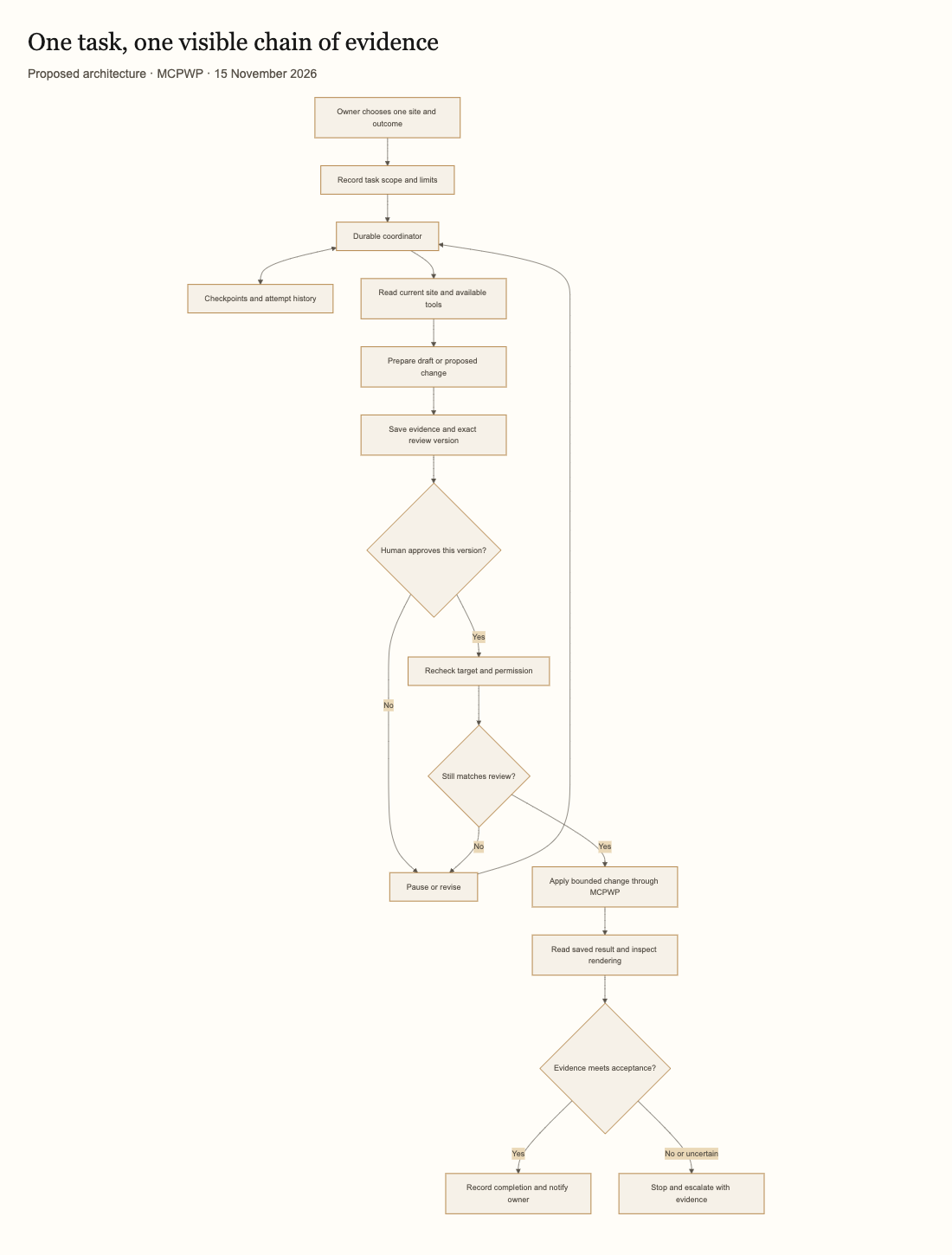
One task, one visible chain of evidence
Save progress, prepare an exact review, and verify the result before marking work complete.
View Mermaid workflow source
flowchart TD
    A[Owner chooses one site and outcome] --> B[Record task scope and limits]
    B --> C[Durable coordinator]
    C <--> D[Checkpoints and attempt history]
    C --> E[Read current site and available tools]
    E --> F[Prepare draft or proposed change]
    F --> G[Save evidence and exact review version]
    G --> H{Human approves this version?}
    H -->|No| I[Pause or revise]
    I --> C
    H -->|Yes| J[Recheck target and permission]
    J --> K{Still matches review?}
    K -->|No| I
    K -->|Yes| L[Apply bounded change through MCPWP]
    L --> M[Read saved result and inspect rendering]
    M --> N{Evidence meets acceptance?}
    N -->|Yes| O[Record completion and notify owner]
    N -->|No or uncertain| P[Stop and escalate with evidence]
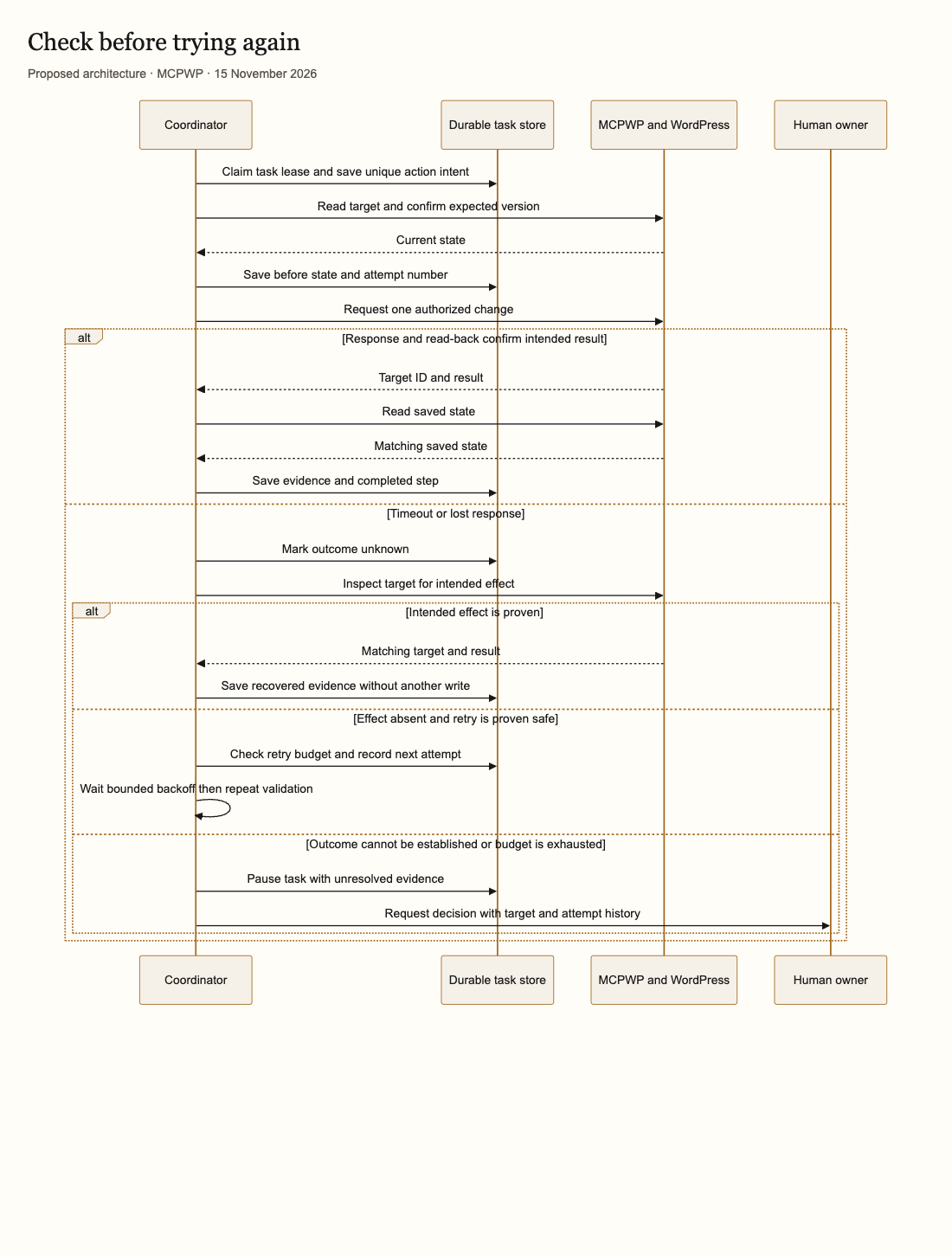
Check before trying again
Inspect an uncertain outcome before retrying a write. Pause when duplicate safety cannot be proved.
View Mermaid workflow source
sequenceDiagram
    participant C as Coordinator
    participant S as Durable task store
    participant W as MCPWP and WordPress
    participant H as Human owner
    C->>S: Claim task lease and save unique action intent
    C->>W: Read target and confirm expected version
    W-->>C: Current state
    C->>S: Save before state and attempt number
    C->>W: Request one authorized change
    alt Response and read-back confirm intended result
        W-->>C: Target ID and result
        C->>W: Read saved state
        W-->>C: Matching saved state
        C->>S: Save evidence and completed step
    else Timeout or lost response
        C->>S: Mark outcome unknown
        C->>W: Inspect target for intended effect
        alt Intended effect is proven
            W-->>C: Matching target and result
            C->>S: Save recovered evidence without another write
        else Effect absent and retry is proven safe
            C->>S: Check retry budget and record next attempt
            C->>C: Wait bounded backoff then repeat validation
        else Outcome cannot be established or budget is exhausted
            C->>S: Pause task with unresolved evidence
            C->>H: Request decision with target and attempt history
        end
    end
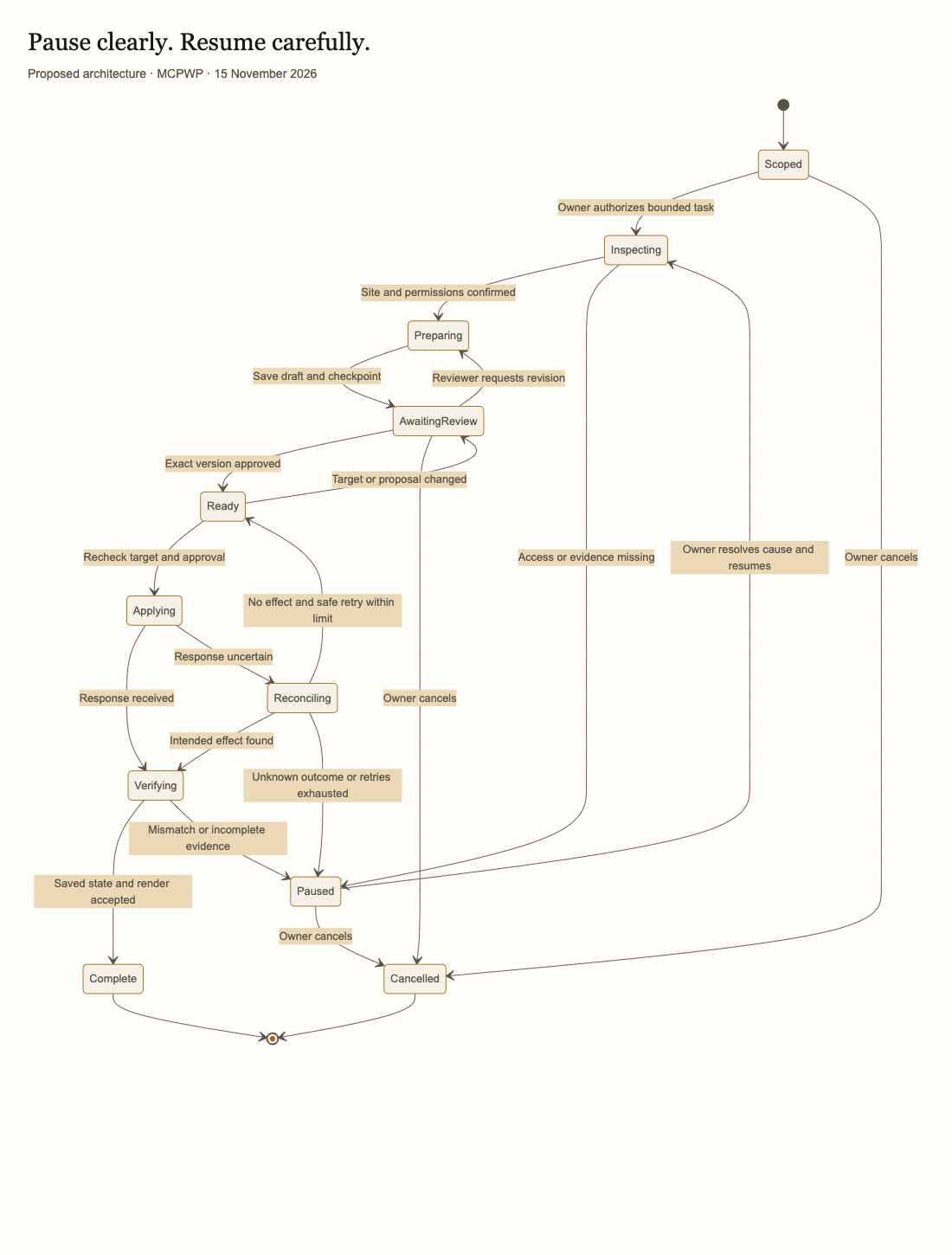
Pause clearly. Resume carefully.
Carry task state across sessions while preserving review, cancellation and human decisions.
View Mermaid workflow source
stateDiagram-v2
    [*] --> Scoped
    Scoped --> Inspecting: Owner authorizes bounded task
    Inspecting --> Preparing: Site and permissions confirmed
    Inspecting --> Paused: Access or evidence missing
    Preparing --> AwaitingReview: Save draft and checkpoint
    AwaitingReview --> Preparing: Reviewer requests revision
    AwaitingReview --> Ready: Exact version approved
    Ready --> Applying: Recheck target and approval
    Ready --> AwaitingReview: Target or proposal changed
    Applying --> Verifying: Response received
    Applying --> Reconciling: Response uncertain
    Reconciling --> Verifying: Intended effect found
    Reconciling --> Ready: No effect and safe retry within limit
    Reconciling --> Paused: Unknown outcome or retries exhausted
    Verifying --> Complete: Saved state and render accepted
    Verifying --> Paused: Mismatch or incomplete evidence
    Paused --> Inspecting: Owner resolves cause and resumes
    Scoped --> Cancelled: Owner cancels
    AwaitingReview --> Cancelled: Owner cancels
    Paused --> Cancelled: Owner cancels
    Complete --> [*]
    Cancelled --> [*]
What would make this ready to run?
- A durable task store, scheduler, and worker with explicit ownership.
- Per-site credentials, scoped access, and protected secret storage.
- Idempotency, leases, retry budgets, cancellation, and failure recovery.
- Human approval tied to a saved version, with expiry and drift checks.
- Monitoring that distinguishes saved, delivered, verified, and complete.
These diagrams specify the intended system. This website redesign does not install or arm that runtime.